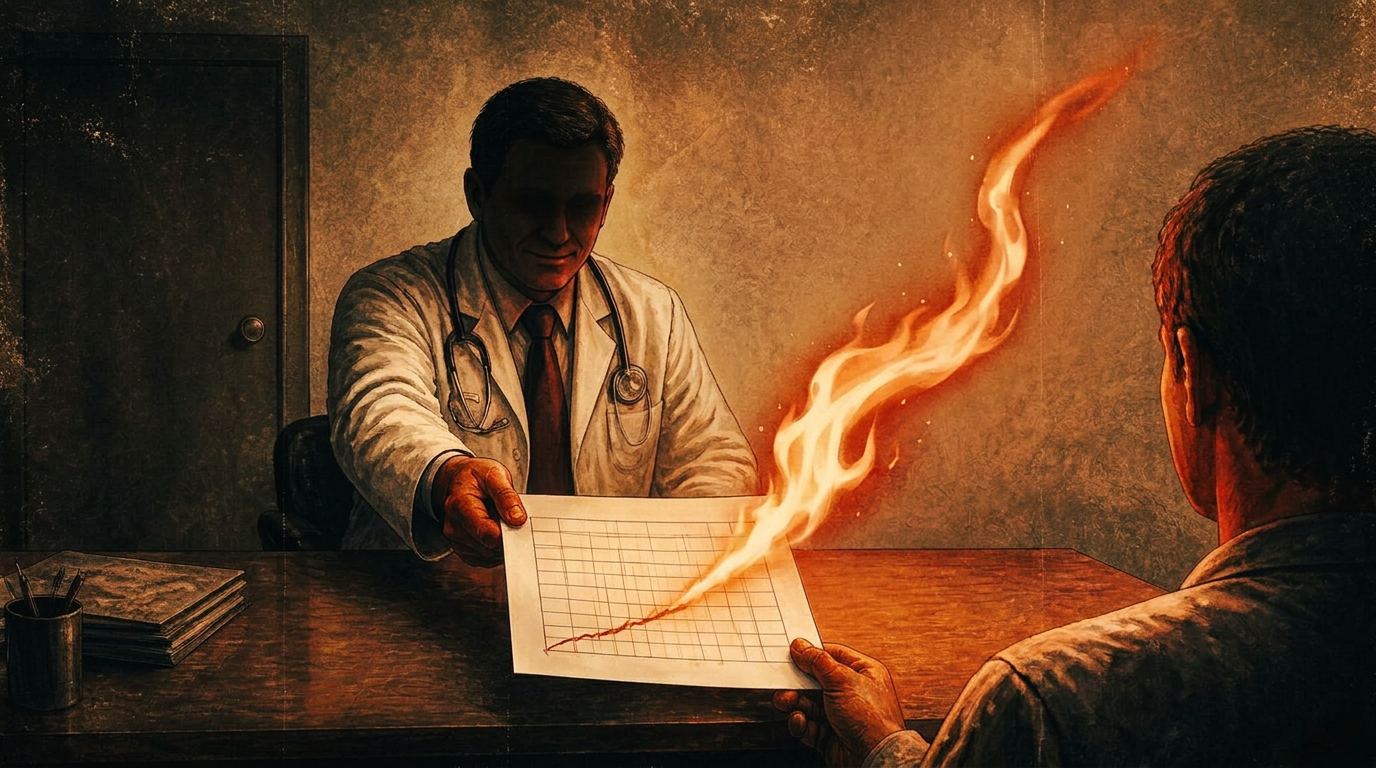
The doctor calls me into his office
Alone.
He closes the door.
There is a printout on the desk, turned so that I can read it. He does not start with small talk.
He has the results.
Then he says the sentence that changes everything.
It is not only you.
The condition is serious. Potentially deadly. And everyone in my family has it. My wife. My children. Something we have all been exposed to, for a long time, in the place where we live.
He cannot tell me exactly what will happen. There are too many variables. Some people do much better than expected. Others deteriorate faster.
The youngest usually carry it the longest.
There are treatments. There is still a great deal we can do.
But the treatment will be difficult. It will require changes. Some expensive. Some uncomfortable. Some things in our lives may have to be reorganised.
And there is one thing he is very clear about.
Waiting makes the odds worse.
I ask him. Are you saying we are going to die?
No.
Are you saying we are going to be okay?
No.
He looks at me. He has said this many times before, I can tell.
I am saying this is serious. You need to take it seriously.
I leave his office.
Outside, people are walking down the street. A bus stops. Someone is laughing. A man is carrying groceries.
The world looks exactly the same as it did before I entered the room.
Mine doesn’t.
All the way home, I rehearse how I am going to tell my wife.
How do you tell the person you love that the results have her name on them too? And the children’s?
We need to talk. There is something I need to tell you. This is about all of us.
There is still hope, a lot of hope. But we need to understand what we are facing. We need to make some decisions.
Together.
Then I open the door.
I come home.
And I don’t tell her.
The appointment was real
That scene did not literally happen to me. No doctor has handed me a printout with my family’s names on it.
But a few days ago, the appointment happened anyway. Not to me alone. To everyone.
On Wednesday 2 September, the UN Environment Programme published a report called Limiting Overshoot. It is written the way that doctor speaks, by people who have said this many times before and weigh every word. Exceeding 1.5°C of warming, the target the world set itself in Paris, is now “widely assessed as unavoidable”. The line will be crossed within the next few years. And whatever we do from here, the report says, some losses are now irreversible and some conditions have changed for good.
The UN Secretary-General summarised the printout in one sentence
“Humanity is speeding past the limit to avoid climate catastrophe.”
Now read the doctor’s lines again.
It is not only you. The condition is serious. The youngest carry it longest. Some of the damage cannot be reversed. There is still treatment. Waiting makes the odds worse.
The office is invented. The verdict is not.
And this time the doctor did not close the door. He said it in public, to the whole world.
On the evening news that night, the verdict got a few seconds. Just before the sports.
I watched it land, and I think I understand why it made no sound.
Those of us who work on climate have known for years that 1.5°C could no longer be held. We read it in the models long before anyone put it in a press release. So we did what you do with a diagnosis you have already accepted. We nodded. Some of us shrugged. It was not news to us, so we did not treat it as news.
And everyone else, the people whose lives the report is about, had no way of knowing what they had just been told. Overshoot is not a word that lands at a kitchen table. A limit the world agreed on a decade ago will be crossed within a few years, and on the news it sounded like the weather.
So the verdict fell between two silences. The silence of those who understood it too well to react. And the silence of those who could not understand it at all.
Then the world did what I do. It went on with its Wednesday.
That invented office is still the most honest description I can give of how it felt to watch. Because this is the part most people get wrong about the burden. The diagnosis I read every day is not mine. If it were only mine, I could live with it.
It belongs to everyone I love.
The doctor called me ten years ago. The appointment has lasted a decade.
And if you work with climate change, the doctor called you long before Wednesday too. Maybe you are a scientist, an analyst, a journalist, an activist, an engineer, an investor. Maybe you have read the IPCC reports that most people will never read. Maybe you know what the words adaptation limit mean. Maybe you know why scientists who have spent their whole careers choosing their words extremely carefully are frightened.
Then the meeting ends.
You close your laptop.
You get on the train.
You go home.
Someone asks: what should we have for dinner?
And you say: pasta?
Two weeks ago
Two weeks ago, I stood on a stage at Sergels torg in Stockholm, warming up the crowd for the largest climate demonstration in the world so far in 2026.
That day, I launched a campaign called The Biggest Lie Ever Told.
And I asked thousands of people to send one word to the leaders who keep telling us there is still time:
NOW.
They shouted it so loudly I could feel it in my chest.
My family was in that crowd. My wife and my children stood in the back and heard me say it.
Then we went home together. We ate dinner. We talked about ordinary things. We agreed the day had gone well.
That was it.
I had just told thousands of strangers that we are out of time. The people I was most afraid for had been standing somewhere in that crowd, listening. And not one of us, on the way home or at the table, said a word about what it meant for us.
I can face a square full of people. I can face ministers, CEOs and television cameras.
I could not say it to the people who came home with me.
The kitchen table is harder.
When I wrote The Biggest Lie Ever Told, the most personal thing in it was three short lines. I ask about school. We eat dinner. We talk about ordinary things.
This essay is what those three lines were hiding.
The prognosis has changed
There is one more thing I need to say about that doctor’s office, because it is the part that has changed inside me.
When I first understood the climate crisis, I understood it was serious. That is why I founded We Don’t Have Time. But I believed, truly believed, that the worst could still be avoided. That if we acted, if we built a movement large enough, if enough of us pushed at the same time, we could hold the line.
Early treatment, full recovery.
Ten years later, I no longer believe that.
Not because the treatment stopped working. It works. The transition is real and it is winning ground. But we delayed it, year after year, and this past year I have watched climate legislation move backwards in country after country while the crisis accelerated in plain sight.
So the honest prognosis is harder now, and I will write it the way I would have to say it out loud.
I still believe we can turn this around. I work on it every waking day.
But I can no longer deny that it is too late to avoid severe damage. The world will pass 1.5°C. That is no longer my opinion. It is the written assessment of the United Nations. Millions of people will die who did not have to.
I do not write that sentence loosely. A peer-reviewed study in Nature Communications, counting temperature-related deaths alone, estimated 83 million additional deaths by 2100 in a scenario where the world reaches 4.1°C, and found that 74 million of them can still be prevented by cutting emissions fast. The deadliest event in human history, the Second World War, killed roughly 70 to 85 million people.
And heat is only the floor. The insurance world’s own risk experts, in the Planetary Solvency report, stress-test what happens when food, water, migration and conflict are counted too. At 2°C or more of warming by mid-century, their risk scenarios reach more than two billion deaths. Not a prediction. A risk, priced the way insurers price the catastrophes they hope never come.
Both of those things are true at once. It is too late to escape the damage. It is not too late to decide how large it becomes.
That is the sentence I would have to say at the kitchen table.
That is why I have not said it.
I don’t tell them
This is the part I have found hardest to admit.
I don’t really talk to my own wife about this.
Not properly.
Of course we talk about climate change. She knows what I do. She knows what I think. We can talk about politics, emissions, heatwaves, some terrible thing that has happened somewhere.
But I mean really talk.
She has heard me say it into a microphone, to an audience full of strangers. She has not heard me say it to her.
The conversation you would have if the doctor had called. The one where you close the door, turn off the television, put the phones away and say:
The conversation I have not had
“I need to tell you what I think is happening. I don’t know exactly what our future looks like anymore. I don’t know what world we should be planning for. I am frightened. And I think we need to talk about it.”
I don’t have that conversation. I haven’t known how.
Maybe I don’t want to frighten her. Maybe I don’t want to put something inside her that she cannot take back out. Maybe I want home to remain the one place where the diagnosis doesn’t exist.
But if I am brutally honest, there is another reason.
I don’t want to hear myself say it.
Thinking something is one thing. Writing about global risk is one thing. Sitting across the table from the person you love and saying I don’t know if the future we are planning for is the future we are going to get is something else entirely.
Once spoken, it enters the room.
It enters your marriage. It enters your child’s bedroom. It enters the mortgage, the savings, the holiday plans, the pension.
Suddenly climate change isn’t something happening to the world.
It is happening to your future. To hers. To the children’s.
So I swallow it. And I carry it alone. I tell myself I am protecting them.
But lately I have started wondering whether I am protecting something else.
I protect the lie by living with it alone.
My wife will read this article. She will learn from a published text what she should have heard across our kitchen table, in private, long ago. I am not proud of that. But if this is the only way I can start the conversation, then let it start here.
The double life
There is a strange double life that comes with working on climate change.
- 11:00Someone shows you what happens to human heat exposure under different warming scenarios.
- 12:00You eat lunch.
- 14:00You discuss whether parts of the world may reach limits to adaptation.
- 18:00You stop at the supermarket.
- 21:00Perhaps you look at your pension account.
- 23:00Then you go to bed.
Two completely different realities. Both of them true.
We become fluent in two completely different realities. In one, we are changing the physical conditions on which human civilization developed. In the other, Tuesday is Tuesday.
And the strangest thing is that both realities are true.
Children still need help with homework. People fall in love, complain about the train, renovate kitchens, book holidays for next summer. There is no soundtrack telling us we are living through something historically extraordinary.
Maybe that is why this is so difficult. Films have trained us to imagine catastrophe as a moment. The meteor appears. The sirens start. Before. After.
Climate change isn’t like that.
There is dinner during climate change. There are birthdays, elections, weddings, jokes, beautiful mornings.
A world can become more dangerous while still looking completely normal on a Tuesday afternoon.
The doctor is not saying we are all going to die
Hold on to this distinction, because everything depends on it.
The science is not telling us that everyone is going to die. It cannot tell me whether Stockholm will be comfortable or difficult when I am old, or whether my children will have happy lives. Anyone claiming to know those things is claiming more certainty than science provides.
But here is what the doctor is telling us.
The planet has warmed about 1.4°C so far. Under the policies currently in place, the UN Environment Programme’s new report puts the world on course for around 2.6°C by 2100. Its most optimistic pathway, in which every country delivers every pledge and every net-zero promise it has made, still peaks at around 1.8°C. And 1.5°C itself will be crossed within the next few years.
Those are tiny numbers. 1.8. 2.6.
They look harmless. That may be one of the cruel jokes of climate change: we use the same unit for planetary warming that we use to decide whether to take a sweater.
But there is another place we use that unit, and there nobody thinks a degree is small.
Every parent knows the scale, from a dark bedroom at three in the morning, a hand on a child’s forehead. A body runs at about 37 degrees. One and a half degrees above that is 38.5, and you are properly ill. You cancel the day. You lie down. Nobody has to tell you it is serious. Your body tells you. Two and a half degrees above is 39.5, and someone is starting to worry about you. Three degrees above is 40. A fever of 40 that does not break is an emergency. No body lives like that for long.
Now read the diagnosis again, as a fever chart.
A body runs at about 37°C. Add the warming numbers to it and the scale stops looking harmless.
Body temperature
- 37°CHealthy body
- 38.5°CClearly ill. You cancel the day.
- 39.5°CSomeone starts to worry about you.
- 40°CA prolonged fever above 40°C is life-threatening
The planet is at 38.4. If every promise on earth is kept, it settles at 38.8. On the policies actually in place, it climbs to 39.6. And if governments add nothing to the laws already on the books, the fever is still rising at the end of the century. On the thermometer, 39.9 and climbing.
- 38.4°C+1.4°CWhere we are now
- 38.8°C+1.8°CIf every pledge on earth is delivered
- 39.6°C+2.6°CWhere current policies point by 2100, if they are kept
- 39.9°C+2.9°CIf governments stop at the laws already passed and add nothing more (IEA scenario). Still rising in 2100.
And we are still discussing whether to bring a sweater.
Scenarios, not predictions. Sources: UNEP, Limiting Overshoot (2026). IEA, World Energy Outlook 2025, Current Policies Scenario.
The planet is not a body, and the comparison will not carry every step. But it carries the one that matters. A degree is not a small number when it is the temperature of the thing you live inside.
The IPCC says the same thing in its own language. Risks increase. Damage increases. Some ecosystems have already hit hard limits to adaptation, and more limits emerge beyond 1.5°C. At around 3°C, a fever of 40, the IPCC projects high or very high risks across many sectors and regions, including widespread systemic impacts.
Read that phrase again.
Widespread systemic impacts.
It does not mean everyone dies.
It means the reassuring sentence, we’ll adapt, has limits.
Why do we treat uncertainty about danger as evidence of safety?
In almost every other part of life, serious uncertainty makes us cautious. With climate change, uncertainty has somehow become a sedative.
The doctor did NOT say: you are definitely going to die.
The doctor DID say:
- The condition is serious.
- It affects the whole family.
- Damage is already occurring.
- The risks rise as the condition progresses.
- Some damage cannot be reversed.
- Treatment exists.
- Earlier treatment gives better odds.
- Waiting makes the prognosis worse.
Would you call that good news because death wasn’t guaranteed?
Source for every line: UNEP, Limiting Overshoot, 2 September 2026.
People are already on the other side of “maybe”
This is where writing from Sweden becomes morally uncomfortable.
Because I can still talk about climate change as risk.
For many people, it is biography.
The 2025 Lancet Countdown found that heat-related death rates per 100,000 people have risen 23 percent since the 1990s. In absolute numbers, heat killed an average of 546,000 people per year between 2012 and 2021.
Heat-related death rate per 100,000 since the 1990s
People killed by heat each year, 2012–2021 average
Of them lived in 2100
Those people were not projections. They did not live in 2100.
They had Tuesday afternoons too.
And climate risk does not enter people’s lives only as death. A farmer doesn’t have to die for his life’s work to be destroyed. A family doesn’t have to drown for its home to become worthless.
We keep imagining only two possibilities: everything is fine, or the world ends. Almost everything that matters happens between those two extremes.
Your house can still be there
Imagine something much less cinematic.
Your house is still standing. The garden is there. The neighbours are there. Nothing looks like the end of civilization.
But the insurance company has changed its calculation.
Europe’s insurance regulator notes that only around a quarter of losses from extreme events in Europe between 1980 and 2024 were insured. As climate risks rise, it expects higher premiums and larger uninsured losses. And in high-risk areas, it warns that insurance, and in turn mortgages, may eventually become unavailable.
Think about how quietly climate change could enter your life.
No fireball. No collapse.
Just a letter.
We regret to inform you.
The house is still there. But the financial assumption underneath it has changed.
Physics entered the spreadsheet.
That is what I mean when I ask whether the future we are planning for will actually arrive. Your pension may exist. Your bank may exist. Your house may exist.
And your plan can still fail.
Your dinner can still be there too
The supermarket does not need to be empty for climate change to matter.
The European Central Bank now studies climate as an inflation risk. It estimates that the 2025 European heatwave alone could add 0.4 to 0.7 percentage points to unprocessed food prices within a year. In the hotter summers already projected, the effects grow larger.
Again: no apocalypse. Dinner still exists. It just costs more.
Then another harvest is hit somewhere else. Then another. Then an exporting country restricts exports. Then a government falls. Then people move. Then another government responds to those people moving. Then a border closes.
Systems connect. That is what makes systemic risk different from a single disaster.
One thing becomes another thing.
Maybe we will be fine
I need to say something that may sound strange in an essay like this.
Maybe my family will be fine. Maybe yours will too.
Maybe wealthy societies adapt faster than expected. Maybe clean energy overwhelms fossil fuels economically. Maybe the worst tipping risks don’t materialise. Maybe we get lucky.
I hope so. God, I hope so.
And human beings are capable of extraordinary things. We have already bent the curve: UNEP notes that projected warming is lower today than it was around the Paris Agreement, because policy, technology and investment changed.
The future is not decided. That is essential.
But there is a mental trick hidden inside the word maybe.
Maybe becomes probably.
Probably becomes surely.
And suddenly I am planning 2046 as if somebody guaranteed it to me.
Nobody did.
We think it will happen to someone else
Earlier this year, researchers published something that stopped me.
A meta-analysis in Nature Sustainability combined 60 datasets involving more than 70,000 people in 17 countries. In 81 of 83 comparisons, people judged their own climate risk as lower than the risk faced by other people.
Comparisons where people rated their own risk lower than other people’s
Countries, more than 70,000 people
Exceptions: farmers in China and South Korea, who had already lived through the damage
Everyone else, everywhere, believed the same quiet sentence. Yes, climate change is terrible. For Africa. For Bangladesh. For farmers. For future generations. For somebody. Somewhere.
But probably not me. Not us.
My family occupies a little protected island inside my imagination.
That island has no scientific basis. It is made of love. And fear.
I think this is why I don’t tell my wife
I used to think silence was strength.
Carry the worry. Don’t burden everyone else. Keep working. Solve the problem.
I am less sure now.
Because if the doctor told me my whole family was ill and I told nobody, what would happen? My wife would keep making plans using information I possessed and she didn’t. We might decide things differently if she knew. We might hold each other differently.
We might be frightened. Yes.
We might cry. Maybe.
But we would be together.
At some point, protection becomes concealment. And concealment becomes loneliness.
That is exactly how climate change feels to me.
Lonely.
Not because nobody talks about it. Millions of people talk about it. But we mostly talk about it one layer above where it really lives. Policy. Carbon prices. Megatonnes. Targets.
We talk about the diagnosis.
We almost never talk about what it means when we get home.
That is not a feeling. It has been measured, year after year, and the number barely moves.
A Tuesday in 2046
Every climate target in the world points at 2030. The EU’s. Sweden’s. The rough halving of emissions the science asked for. 2030 is three and a half years away. Sweden votes on 13 September, and 2030 is the election after that. And on current trends, the scientists who track the world’s remaining carbon budget expect human-induced warming to reach 1.5°C around 2030.
That is the problem with 2030 for what I want to show you. On that Tuesday, nothing will look different. No siren. A line in a report, a few seconds before the sports. 2030 is close enough to touch and too close to show anything.
So let me go further. Not a forecast. Not a prediction. One plausible world among many.
But first, hold the year itself. 2046 sounds like science fiction. It is twenty years away. Twenty years ago it was 2006. I was 27 years old, an adult in the middle of a life, and I remember it like last week. For a child, twenty years is an eternity. For the adults this essay is written for, it is nothing.
2046 is exactly as close as 2006.
It is 2046. I wake up.
Stockholm is still Stockholm. Civilization did not collapse. There are cafés. There are elections. People complain about politicians. Teenagers flirt. Someone has released a terrible song that everybody secretly loves.
Life continues.
But I do not know what the summers of the 2040s bring, or where. Stockholm or Valencia. Skåne or Kansas. Maybe heat alerts are ordinary and harvest failures elsewhere keep pushing up our food prices. We already saw the beginning of that in 2026, when extreme weather hit European harvests and was expected to drive food prices more than war. Insurance costs more. Certain properties have become financial liabilities. Europe spends enormous amounts protecting infrastructure, coastlines and cities.
Or maybe what we thought would hit others harder hits us. Maybe the Atlantic circulation weakens dramatically, or even collapses, and northern Europe changes in ways we did not expect. Maybe, after decades of watching other people leave their homes, we are the ones wondering whether our children should build their lives somewhere else.
Migration has become one of the defining political questions of the era. The World Bank has estimated that climate change could drive as many as 216 million people to move within their own countries by 2050, while noting that strong climate action could cut that number by as much as 80 percent.
Some political systems have become uglier under pressure. Some communities have become stronger. There is extraordinary new technology, and there is loss.
In 2046 I am 67, the age when we planned to start living on what we had put aside. But I am no longer sure it buys the life we imagined. In 2025, actuaries projected that global GDP could halve between 2070 and 2090 if climate change remains unchecked. I wrote about it in Forbes, but we never really talked about what it meant for us.
I do not know whether the flood comes to Stockholm. I know the invoice does.
Our pensions are invested in the world. Our food is priced by the world. The company that insures our house is reinsured by it.
And by the time the deepest damage the actuaries can see arrives, our children will be the age I am now.
Maybe life is good. I desperately hope it is.
But perhaps they look at my generation differently than I looked at my parents.
Because we knew.
That last part is hard for me to imagine. So normally I don’t.
- Your house can standandand become uninsurable.
- Your pension can existandand buy less than you planned.
- Supermarkets can stay openandwhile food becomes more volatile and expensive.
- Democracy can surviveandwhile becoming angrier and less stable.
- Your child can have a good lifeandwhile inheriting far more danger than you did.
Civilization does not have to collapse for your plans to collapse.
This is not a call to panic
I can already hear someone saying: what do you want us to do? Terrify our children? Sell our homes? Build bunkers?
No.
That would be another attempt to manufacture certainty where none exists.
I am not saying I know exactly what is coming. I am saying we need to stop pretending that we know, and that what is coming is normal. There is a huge difference.
When a doctor gives you a serious diagnosis, you do not organize your funeral. You ask: What can we do? What are the odds? How do we improve them? What would we regret not doing?
And perhaps most importantly:
How do we go through this together?
Hope is not reassurance
For years we have tried to communicate climate change without frightening people too much. I understand why. Fear can paralyse. Doom becomes an excuse to do nothing. People need agency.
But I increasingly worry that we have confused hope with reassurance.
They are not the same thing.
Two different sentences
“Reassurance says: everything will be okay. Hope says: things may not be okay, but what we do can still change what happens.”
Reassurance requires us to soften reality. Hope requires us to enter it. That is much harder.
There is an old idea I keep returning to: before you can make a good decision, you have to become willing to see what is actually there. Not what you fear is there. Not what you desperately want to be there. What is there.
Fear is not a good compass. But neither is comfort. Flee your fear and you run toward fantasy. Protect your comfort and you sit still while danger approaches.
The point is not to become terrified.
The point is to become free enough to look.
Then choose.
How the lie actually survives
When I wrote The Biggest Lie Ever Told, I thought the lie was: we have more time. I still believe that.
But now I think I understand how the lie survives.
It survives inside millions of small acts of silence.
Including mine.
A scientist who tells colleagues what she sees but not her family. A policymaker who reads the risk assessment and then writes a speech designed not to frighten voters. A journalist who understands the physics but frames the story as one more political disagreement. A CEO who knows the company’s physical risks but presents another smooth twenty-year growth curve.
A father who comes home from reading another climate report and asks what is for dinner.
None of these people are evil. I am one of them.
That is what makes this difficult. Maybe the biggest climate lie is no longer maintained primarily by liars.
Maybe it is maintained by frightened people who know the truth and cannot bear to bring it home.
And then I turn on the television
The same week the UN put the verdict in writing, I watched a climate debate on national television. Sweden votes on 13 September, and this was an evening the broadcaster had set aside for the climate.
The entire conversation was about fuel prices. Who had lowered them. Who might dare to raise them.
Put the two side by side. On one screen, the political parties of my country spent an hour on the price of petrol. On the other, the United Nations said the line the world set itself in Paris will be crossed within a few years.
And I felt something close to despair.
Not because cost is unimportant. Cost matters. Fairness matters. Who pays matters.
But suddenly I saw the doctor’s office again.
Imagine getting the diagnosis I described at the beginning. You gather your family. You tell them the disease is serious, that treatment can still work, that delay makes the outcome worse. And the family spends the whole evening arguing about how irritating and expensive one part of the treatment is.
Before the question of cost comes an older question: what gives us the best chance? How do we protect the children?
The atmosphere doesn’t vote.
Physics doesn’t negotiate.
And yet we keep negotiating with ourselves.
I don’t know what to do anymore
Here is where I am supposed to give you the answer. I don’t have one.
Perhaps that is the hardest confession in this essay.
I know many things we should do. Stop expanding fossil fuels. Build clean energy much faster. Electrify. Cut methane. Adapt cities. Protect food and water systems. All of that matters enormously.
But the thing I no longer know how to do is this:
How do you make a society emotionally understand something it already intellectually knows? I don’t know.
How do I talk to my wife without putting all my fear inside her? I don’t know.
How do I talk about an uncertain future without stealing the joy of the future from my family? I don’t know.
How do we face the possibility of terrible outcomes without deciding they are inevitable? I don’t know.
How do we preserve hope without turning hope into another drug that lets us avoid reality? I don’t know.
I really don’t.
But I know one thing
I cannot keep doing this alone.
I don’t think it is healthy. And I don’t think it is honest.
I cannot spend my days looking at the diagnosis and then come home and pretend to the people I love that I have not seen it.
Perhaps this article is partly an act of cowardice. Perhaps I am writing publicly what I have been afraid to say privately. Perhaps this entire essay is the conversation I have not known how to have at my own kitchen table.
If so, I will have to live with that. But I suspect I am not alone.
This summer, during London Climate Week, I was invited to a high-level gathering with King Charles III, António Guterres and leaders preparing the ground for the next UN climate summit. The rooms where the world is supposedly being managed.
In one of them, I found myself talking with one of the world’s leading climate scientists. A man who has advised governments for years, whose words pass through the most careful filters in science before they reach a minister’s desk.
He did not give me the version from the reports.
He told me how scared he is of the future.
And then he cried.
I will not say who he is.
But earlier in this essay I wrote that scientists who spend their whole careers choosing their words carefully are frightened. I did not write that as a guess. I have stood next to it.
Composed in the meeting. Breaking in private, with someone who happens to understand.
That is the double life, all the way to the top.
I suspect there are many of us walking around with this thing inside us. Scientists. Parents. Journalists. Activists. People who have looked long enough at the numbers to understand that this may become very, very hard.
We meet each other. We nod. Sometimes we make dark jokes.
Then we go home.
And protect everyone else from what we know.
Maybe that has to stop. Not because everyone needs to be frightened.
Because nobody should have to carry this alone.
Start with the people you love
I don’t think the answer begins with shouting louder. I don’t think it begins with another terrifying graph.
Maybe it begins at home.
Not: we’re doomed. Not: your children have no future. None of those things is something I know.
Maybe it begins with something much more honest.
The words I am trying to find
“I’m scared. I’ve learned things I find difficult to live with. I don’t know exactly what they mean for us. I still believe there is so much worth fighting for. I still believe our choices can change the future enormously. But I don’t want to pretend with you anymore. Can we talk about it?”
Imagine millions of those conversations. Between partners, parents and children, friends, colleagues, neighbours.
Not political arguments. Not debates about whether climate change exists.
Conversations about what we love. What we are afraid of losing. What risks we would never knowingly impose on our children. What kind of future we are actually planning for.
And what we might do differently if we stopped assuming that future was guaranteed.
Maybe something changes when the diagnosis becomes personal.
The trap I fell into first
There is a second confession that belongs here, because I know exactly what many of you will do with your fear once you finally speak it.
You will try to become clean.
When the climate crisis truly landed in me, the first thing I did was change my own life. What I ate, how I travelled, what I bought. It is what almost everyone does when the diagnosis arrives, and I still think it matters. Living in line with what you know keeps you sane.
But hidden inside it is one more self-deception, and I lived inside this one too.
The belief that individual action can solve this.
It cannot. Not yours, not mine, not our carefully curated circles of like-minded friends. A crisis created by systems is not cancelled by lifestyles.
It is a bit like believing you could have stopped the Second World War by being a pacifist. Personal peace was a fine thing to practice. It did not stop the war. People acting together did.
And when engagement stays individual, something uglier happens. We start pointing at each other instead of at the problem. It is the rich. It is the others. It is the people who fly. I live correctly, so I have done my part. The forces working against us could not design a better outcome: millions of frightened people auditing each other’s groceries while my team counts 45 climate rollbacks in a single year passing through parliaments and boardrooms, pushed by lobbyists working to drill for more oil.
Not one of those rollbacks is stopped by a vegetarian dinner.
They are stopped the way the tobacco lie was stopped. By people who organized, documented, sued, voted and refused to be quiet.
By resistance, not purity.
So yes, change your life. I did, and I am glad. But do not confuse living right with fighting.
The kitchen table conversation is where this begins.
The resistance is where it has to go.
Planning is not giving up
And alongside the fight, we plan. Not instead of resistance. Next to it.
Not for the end of the world. For uncertainty.
Families can ask whether their homes are exposed to heat, fire or flood. Cities can prepare cooling, water and emergency systems for the climate that is coming rather than the climate that has gone. Banks can stop pretending physical risk is a distant reporting issue. Pension funds can stress-test disorderly futures, not only smooth ones. Governments can speak honestly about food security, migration, insurance and adaptation.
And all of us can fight much harder to prevent every fraction of warming we still can.
The report that delivered the verdict
“Every fraction of a degree avoided reduces risks. Every year by which overshoot is shortened reduces exposure.”
Planning does not mean accepting the worst.
Planning is what you do when you are determined to stop the worst from taking everything you love.
I still want the ordinary future
This is perhaps the most painful part.
I want the lie to be true.
I want ordinary Tuesdays. I want dinners where nobody talks about climate change. I want ridiculous family arguments. I want Christmas. I want the people I love to complain about trivial things when they are old. I want grandchildren growing up in a world where they roll their eyes when we tell them how close we came.
I want normal. I desperately want normal.
Maybe that is why I have protected it so fiercely inside my imagination.
But wanting something does not make it true. And loving someone does not mean hiding every frightening truth from them.
If the doctor calls me in, I owe the people I love the dignity of knowing what he said. Not every horrible possibility. Not every nightmare inside my head. The truth.
Including the most important part:
There is still treatment.
The same report that delivered the verdict describes it. Cross the line, hold the peak as low as we possibly can, then bring the temperature back down. The head of the UN Environment Programme put it plainly: “1.5 target is still the goal. But now we need to approach it differently from above.”
What happens is still partly in our hands. The difference between the futures in front of us is enormous. We can still save lives. We can still make the odds better.
But first we have to stop walking out of the doctor’s office and behaving as though the appointment never happened.
The quieter lie
I wrote The Biggest Lie Ever Told because I could no longer accept the sentence: we have more time.
Now I think there is another lie beneath it. Much quieter. Much more intimate.
And I have been telling it myself.
Every time I come home carrying what I know and say nothing. Every time I make a long-term plan without allowing the climate into it. Every time I reassure the people I love without knowing whether my reassurance is true.
We’ll probably be fine.
Maybe we will. I pray we will.
But perhaps love demands something more from us than probability.
Perhaps love requires us to look directly at the danger.
Together.
And then do absolutely everything we can to improve the odds.
I still don’t know exactly how to have that conversation with my wife. But I know I need to.
Because I cannot keep protecting the lie by living with it alone. And maybe you can’t either.
So if someone sent you this text, read it once more.
They were not sharing an article. They were trying to start the conversation they have not known how to begin.
Sit down with them. Ask what they are afraid of. Say: me too.